
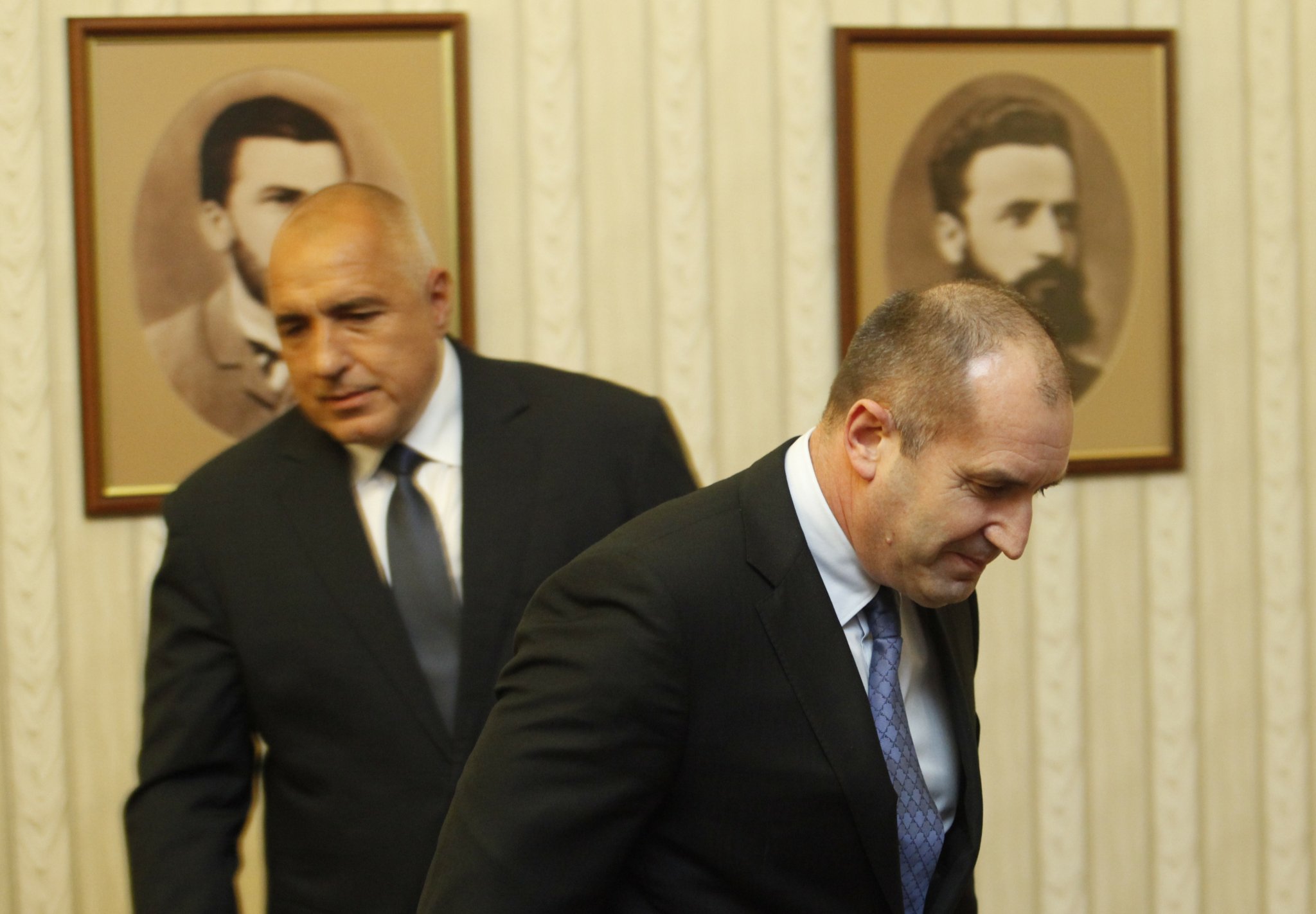
The pilot who became president and will be prime minister now, is the new “savior” of Bulgaria which is tired of corruption and constant elections. But who could Radev rule with?
The former pilot of MiG-29 and until recently president of Bulgaria, swept like a typhoon through the snap parliamentary elections held on Sunday and will probably bring the country a stable government after appearing at the polling station eight times in the last five years.
Exit polls say that Rumen Radev and his coalition “Progressive Bulgaria” won 38 or 39 percent of the vote, which is much more than the surveys conducted last month, and even than the latest survey published on Friday. The polls gave Radev’s coalition somewhere around 31 percent, but this result will be even higher.
Whether Radev’s historic success will be enough to secure a majority in the parliament on his own or whether he will have to enter a coalition depends on which parties will pass the threshold of four percent. Several exit polls show that the socialists from the Bulgarian Socialist Party are somewhere around the threshold and if the pass it, there is a possibility for them to be a coalition partner. If none of the possible partners enter a coalition with “Progressive Bulgaria”, Rumen Radev as a prime minister could lead a minority government.
A victory as large as this one, won by a single party, has not been recorded in Bulgaria’s recent parliamentary history since 2009, when Bojko Borisov and his GERB won with a similar result in its first election.
Seventeen years later, Borisov and GERB recorded a historic defeat in the elections with high turnout by Bulgarian standards, probably around 50 percent. Exit polls also give GERB only 14 to 16 percent of the vote and that is almost half less than public opinion polls in the last month (which was around 20 percent).
In the day full of electoral surprises, the centrist coalition “Continue the Change – Democratic Bulgaria” (CC-DB), for which the exit polls predicted 14 percent of the vote, fared better than expected and it is mentioned that this coalition could be in a close race with GERB for the second place.
Besides GERB, there are many other losers on Sunday’s elections.
First, it is the “Movement for Rights and Freedoms – New Beginning” of the oligarch Deljan Peevski, which reached 8 percent of the vote (while the polls until recently predicted around 13 percent). A bigger loser than Peevski could be the nationalists from “Revival” who are struggling to pass the threshold of four percent, although some exit polls said that their support is around 5 percent. This poor support for them is probably due to the fact that a large number of their voters have shifted towards Radev’s coalition.
All other parties sank far below the threshold of four percent for entering parliament. These elections could be the end of Slavi Trifunov’s party whose representatives have participated in several governments over the past five years. In today’s vote, their result will be around 1 percent. The previous parliamentary parties, as well as the Ahmet Dogan’s Alliance for Rights and Freedoms, which have slightly more support, but at the same time are far from the threshold of 4 percent, will definitely not enter the parliament.
For a majority to elect a government, 121 MPs are required, but for a constitutional majority to amend the key laws in the judicial sphere, 160 MPs are required. There are many debates in Bulgaria tonight about whether Borisov’s and Peevski’s parties could gather together 80 MPs to block such constitutional changes. In Bulgaria, exit polls are not always accurate, but generally, they show who wins and who loses. The counting of votes by the electoral commission sometimes adds and sometimes subtracts an MP or two. A lot will depend on how Bulgarians abroad vote and if they will support Radev more than the two parties that are embodiment of the status quo in Bulgaria and are noted for being corrupt and for working in the interests of the oligarchy.
A few minutes before the end of the voting, Radev said that he hoped that with CC-DB he will be on the same page to replace the Supreme Judicial Council and that is one of the key barriers to judicial reform. He refused to answer who he would govern with before the final election results were announced.
“We will do everything possible to not have to go to elections again. This is harmful for Bulgaria. This means that we are going from one crisis to another and we must work very seriously to be able to get out of these crises,” Radev said.