
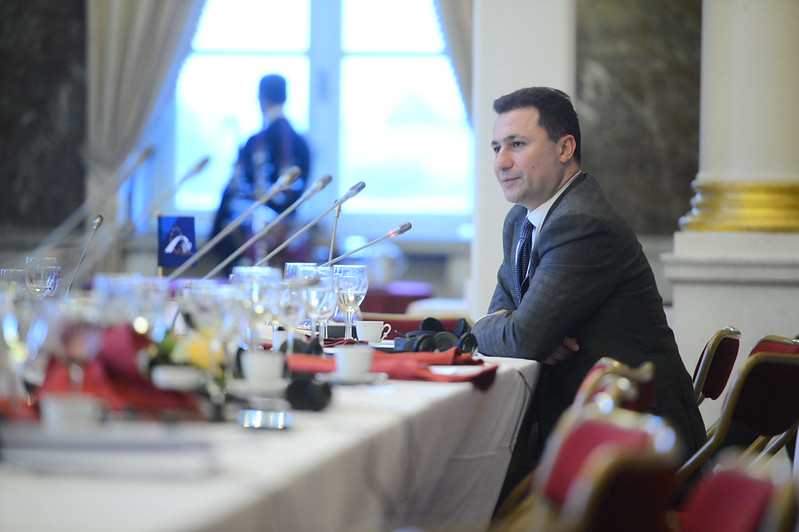
Asylum is not written in stone, writes the Hungarian media “Telex”. And it can be annulled if the allegations were not true. Nikola Gruevski can be extradited to Macedonia if our country requests it, or he can stay in Hungary. At least for now. At this stage, there is no active legal mechanism that would allow authorities in Hungary to act against Nikola Gruevski. Without a valid extradition request or an active international notice from Interpol, there is no legal basis for detention or transfer.
Last Monday, after the winner of the elections in Hungary, Peter Magyar, at his international press conference pointed out the two Polish ex-ministers and Gruevski as asylum seekers from whom his country should get rid, the governments in Skopje and Warsaw welcomed this with mixed expectations. “Hungary is not a dumping ground for internationally wanted criminals”, Magyar said.
The Polish government of Donald Tusk is eagerly waiting the extradition of the two refugees from justice, the former Minister of Justice, Zbigniew Ziobro, and his deputy, Marcin Romanowski, while Hristijan Mickoski would not like to see his predecessor in VMRO-DPMNE in the country, causing divisions in the party, although he publicly said that Gruevski will be taken to prison if he appears at the border.
The influential Hungarian media “Telex” published a larger story about the possible fate of the three refugees who got political asylum by Viktor Orban’s government. The absence of an international arrest warrant is largely linked to procedural and political factors. Requests for international notices must be periodically renewed and supported by updated legal documentation. If such steps are not taken in time, the notice can lapse, effectively removing the international legal pressure.
“Telex” wrote that “the formula is complicated because of two reasons: on the one hand, they all have asylum, and on the other hand, there are international warrants for all of them. Besides this, the extradition of Gruevski is clearly not being pushed by his country, due to domestic political reasons.”
Gruevski’s current status in Hungary further complicates the situation. He was granted political asylum, which provides an additional layer of legal protection. While asylum does not automatically block all legal actions, it significantly raises the threshold for extradition and requires careful legal and political consideration.
But at the same time, the text emphasizes that “asylum is not written in stone.” The article about Nikola Gruevski says:
“Gruevski, who has been in Hungary the longest of the three, escaped in Budapest in November 2018 to avoid a two-year prison sentence with the help of the Hungarian government. Since then, the politician who is also accused of mass wiretapping, has been sentenced to 10 years in prison, in absentia in two corruption cases. In Gruevski’s case, the request for extradition sent by the previous Macedonian government has already expired, while the current government has not renewed the request, and there is no Interpol arrest warrant. Even if there was one, it would not be executed due to his status as a political refugee, which provides him protection.
The status of refugee is an objective fact and its recognition requires an examination of the existing circumstances. If the examination shows that the applicant has a well-founded fear of persecution, in that case, the status can be granted.” A search on the Interpol’s website for international arrest warrants shows that Gruevski is not on that list.
A “Telex” reporter spoke to Tamas Hofmann, a lecturer at Corvinus University and an international lawyer.
“However, if it turns out that the initial assessment is incorrect, that there is no persecution, but that the applicant is still the subject of a simple criminal procedure, then the initially positive decision can be annulled,” says Hofmann.
According to him, the process is not long: the administrative decision for annulling the status can be appealed in court, but the decision is quick. In order to do this, a review of the status must be initiated and the Hungarian authorities can do it themselves. “Telex” further writes about what the actions of the future Hungarian government could be.
“However, in Gruevski’s case, if there is still no international arrest warrant or a request for extradition against him, the Hungarian authorities do not have further action and the politician does not automatically have to leave Hungary. But he is not an EU citizen and because of that he has to find a legal basis for his stay in the EU. If he does not obtain a Schengen visa from Hungary or from another state that is member of the EU, Gruevski will have to leave the EU, especially since the authorities cannot simply detain him and hand him over to Macedonia. This would require a valid extradition request from that country or an Interpol arrest warrant. Apparently, the government in Skopje does not have such a plan,” “Telex” writes.
In the case of the two former members of the Polish government, the formula is complicated because of the EU citizenship. However, this situation is not permanent. If authorities in North Macedonia decide to renew their legal efforts and submit a new, properly documented request, or if a new international notice is issued, the legal landscape could shift quickly.
For now, Gruevski remains in a relatively stable legal position in Hungary. Nevertheless, his future will depend on whether new legal steps are taken and how the political environment evolves in both countries.