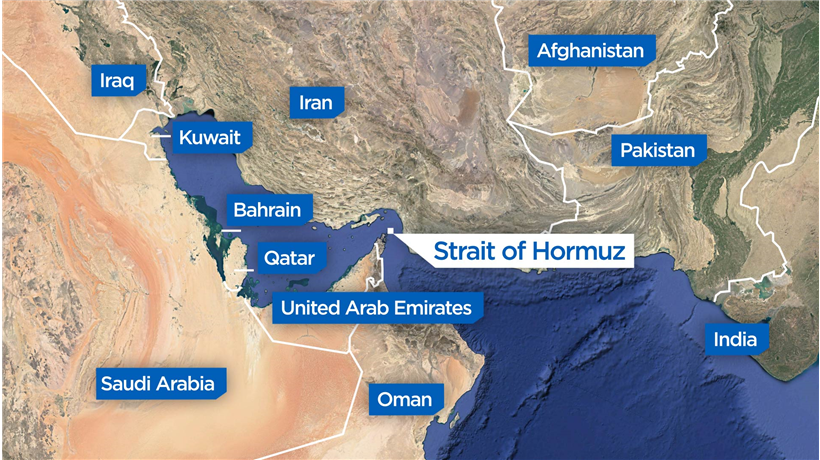
If the Strait of Hormuz is not reopened, we could face the largest energy crisis in history, Greece’s Minister of National Economy and Finance and President of the Eurogroup, Kyriakos Pierrakakis, told CNBC. He warned that when all factors are considered, one-third of fertilizers pass through this strait—along with sulfur, helium, and petrochemicals—making it a potentially enormous risk.
Pierrakakis said that the Executive Director of the International Energy Agency, Fatih Birol, described the current situation as “potentially the largest energy crisis in history, even greater than the three previous ones combined: the two oil shocks of the 1970s and the Russian invasion of Ukraine.”
“The data confirms this assessment. For example, if we analyze 1970, the total loss of oil barrels per day was nearly 10 million. Today, the loss reaches 13 million barrels per day. If natural gas is also taken into account, the trend is even sharper than in 2022. Back then, measured in billion cubic meters (BCM), supply fell from 155 to 80, meaning a cumulative loss of 75. If these figures are calculated on an annual basis today, it amounts to a loss of approximately 110 BCM. Therefore, when all three cases are considered, we may be facing the largest energy crisis in history if the Strait of Hormuz is not reopened soon,” Pierrakakis said.
Why is the Strait of Hormuz so critical?
The Strait of Hormuz is one of the most important energy chokepoints in the world. Roughly 20% of global oil supply passes through this narrow waterway every day, along with significant volumes of liquefied natural gas (LNG). Any disruption immediately affects global energy markets.
Because supply chains are tightly interconnected, even a partial blockage can trigger a sharp rise in prices. Oil and gas markets react quickly to uncertainty, meaning that geopolitical tensions alone—without a full closure—can drive prices higher.
Global consequences of a potential shutdown
If the strait remains closed or restricted, the consequences could be severe:
- Surging energy prices worldwide, affecting fuel, electricity, and heating costs
- Inflation pressure, as higher energy costs ripple through food, transport, and manufacturing\
- Supply shortages, particularly in Europe and Asia, which rely heavily on energy imports
- Industrial slowdown, especially in energy-intensive sectors like chemicals and fertilizers
In addition, the disruption of materials such as petrochemicals, sulfur, and helium could impact key industries—from agriculture to high-tech manufacturing.
Why this crisis could be worse than previous ones
Unlike past crises, today’s global economy is more interconnected and more dependent on stable energy flows. At the same time, the energy transition is still incomplete, meaning fossil fuels remain essential.
This combination makes the current situation particularly fragile. A prolonged disruption in the Strait of Hormuz would not only affect energy supply but could also trigger a broader economic shock, impacting growth, employment, and global trade.
Geopolitical risks and market instability
Beyond supply disruptions, the situation around the Strait of Hormuz carries serious geopolitical risks. Any prolonged tension in the region could escalate into a wider conflict, further destabilizing global markets.
Energy markets are highly sensitive to uncertainty. Even the possibility of disruption in the strait can lead to speculative trading, pushing oil and gas prices higher before any real shortage occurs. This creates volatility that affects not only governments and companies, but also everyday consumers.
Impact on Europe and global trade
Europe is particularly vulnerable due to its reliance on imported energy. While diversification efforts have increased since the Russian invasion of Ukraine, alternative supply routes cannot fully compensate for a major disruption in the Gulf region.
Global trade would also be affected. Higher shipping costs, insurance premiums, and delays in deliveries could slow down international commerce. This would put additional pressure on already fragile supply chains.
Long-term implications
If the crisis persists, it could accelerate major structural changes in the global energy system. Countries may increase investments in renewable energy, nuclear power, and domestic production to reduce dependence on critical chokepoints.
At the same time, governments could introduce emergency measures such as energy rationing, subsidies, or strategic reserves release to stabilize markets.
The situation highlights how a single strategic location like the Strait of Hormuz can influence the entire global economy. The coming weeks will be crucial in determining whether tensions ease—or escalate into a crisis with far-reaching consequences.